

If you’ve got five days, a camera bag, and ₹50,000 to spend, the decision between Corbett and Ranthambore can feel harder than choosing the lens to pack.
Both parks are famous. Both can deliver unforgettable sightings. expectations are unrealistic.
So let’s make this simple.
If your main goal is tiger portraits in open terrain, one park has an edge. If you want richer forest moods, varied wildlife, and a different photographic feel, the other becomes very tempting.
For a smart November trip on a controlled budget, the details matter more than hype.
First, Why November Is a Good Time
November is one of those sweet spots.
The heat hasn’t become punishing. Dust levels are manageable. Landscapes still carry some post-monsoon freshness. Animals are active, and mornings can be beautiful for soft light.
You may get chilly early drives, especially in open gypsies, so carry layers.
Photographers usually love November because the light can be gentler than harsh summer months.
Corbett: What It Feels Like
Jim Corbett National Park feels wild in a classic jungle sense.
Dense forests.
Riverbeds.
Mist in the morning.
Elephants moving through sal trees.
Bird calls everywhere.
And yes, tigers are there—but they can be harder to photograph because habitat is thicker.
That matters.
Seeing a tiger and photographing a tiger cleanly are two different things.
Ranthambore: What It Feels Like
Ranthambore National Park feels more dramatic.
Dry deciduous forest.
Open lakes.
Ancient ruins.
Rocky ridges.
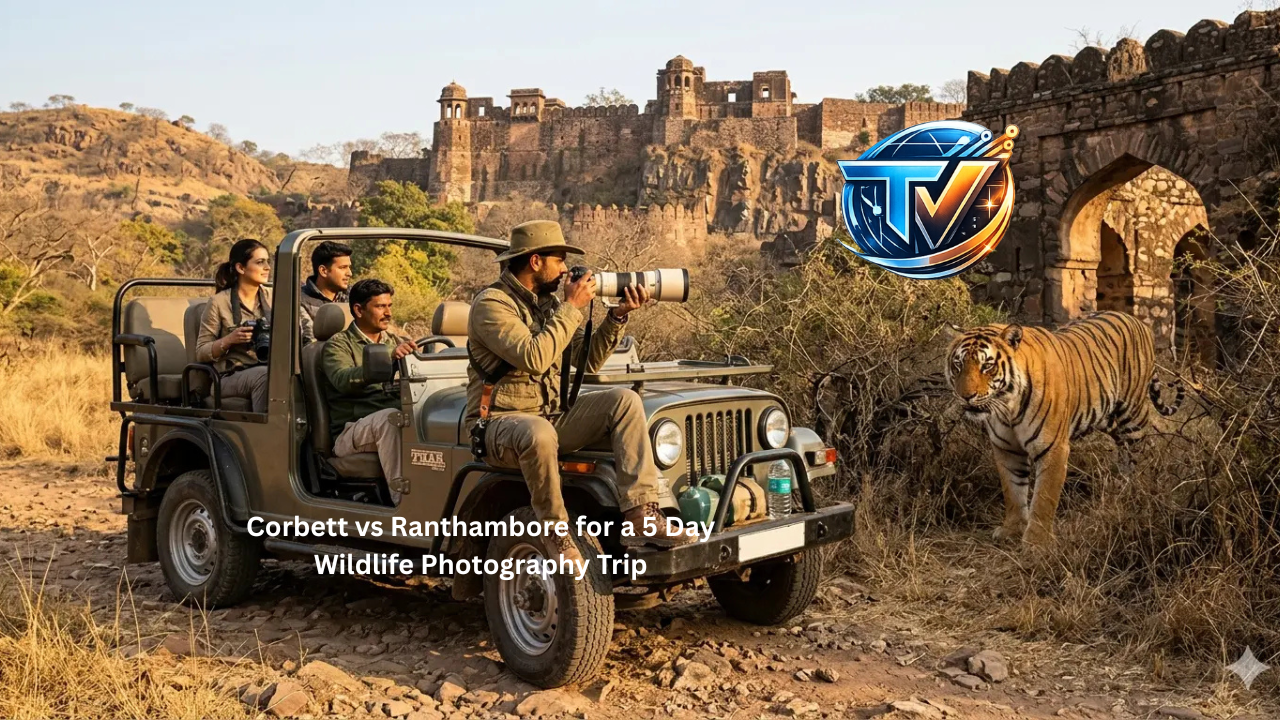
Historic fort backdrop.
And because terrain is more open in many zones, tiger photography can be easier when luck lands on your side.
You may get longer visual contact too.
That’s gold for photographers.
If Tigers Are Priority Number One
Let’s be honest.
Many wildlife photographers say “I’m open to everything,” but secretly mean “please give me tiger shots.”
If that’s you, Ranthambore National Park usually has the stronger photography appeal for a short five-day trip.
Open spaces help autofocus.
Cleaner sightlines help composition.
You may shoot behavior rather than just stripes vanishing into brush.
That’s a major difference.
If You Love Mood, Habitat, and Variety
If you enjoy the full wilderness story—not just big cat obsession—Jim Corbett National Park becomes very attractive.
You can photograph:
Elephants
Deer species
Birdlife
Landscapes
River scenes
Forest atmosphere
Sometimes the best image from a trip isn’t a tiger. It’s fog over grassland with a tusker in soft dawn light.
Corbett can give you those moments.
Budget Reality: Can ₹50K Work?
Yes, if you plan smartly.
₹50,000 for five days is workable for either destination, but you need balance.
Think mid-range stay, shared safaris where possible, train or budget flight choices, and controlled food spending.
Luxury lodges? Probably not.
Comfortable, practical wildlife trip? Absolutely.
Approx Budget Split
A realistic ₹50K solo budget might look like this:
Travel: ₹8K to ₹18K depending on city and mode
Stay (4 nights): ₹12K to ₹20K
Safaris: ₹15K to ₹25K depending private/shared and number
Food/local transport: ₹5K to ₹10K
Now here’s the thing: safari pricing and zone choices can swing totals fast.
Which Is Easier on Budget?
Usually Jim Corbett National Park can offer slightly more flexibility depending on travel route and lodging choices.
But Ranthambore National Park often gives stronger “worth it” feeling for photographers if tiger images are your mission.
So cheapest and best-value are not always the same thing.
Travel Time Matters on a 5-Day Trip
Five days is not long.
If two days vanish in transit stress, you lose valuable safari chances.
Choose the park that is easier from your starting city.
Example:
From Delhi, Corbett is commonly convenient by road/train mix.
Ranthambore can also work well via train or Jaipur route.
The smartest trip is often the one with less travel fatigue.
Photography Style Differences
Corbett Style
Longer lenses help.
Patience matters.
Forest scenes reward storytelling.
You may shoot through foliage, changing light, layered frames.
Great for photographers who enjoy challenge.
Ranthambore Style
Cleaner subjects.
More obvious compositions.
Tiger near lake edge? Castle ruins behind? Dust trail on track?
These frames can happen.
Great for impactful portfolio images.
A Real-Life Example
Imagine two photographers.
One wants a frame-worthy tiger staring straight into lens.
The other wants a complete wildlife experience with birds, forests, elephants, and atmosphere.
First person likely prefers Ranthambore National Park.
Second may come home happier from Jim Corbett National Park.
Neither is wrong.
November Crowd Factor
November is popular.
Book early.
Good safari slots disappear first.
Better zones go fast.
Decent stays near gates fill up.
If you delay planning, budget gets squeezed because only expensive options remain.
This is especially true for weekends.
Gear to Carry
Keep it practical.
One main telephoto lens.
Backup batteries.
Dust cloth.
Bean bag or support.
Muted clothing.
Warm layer for mornings.
Don’t overpack. Safari vehicles are not gear studios.
My Honest Recommendation on ₹50K
If you are specifically a wildlife photographer with only five days and want highest chance of strong tiger images, choose Ranthambore National Park.
If you want a richer forest experience, broader biodiversity feel, and more atmospheric nature storytelling, choose Jim Corbett National Park.
That’s the cleanest answer.
What I’d Personally Do
With five days only?
I’d lean Ranthambore.
Why?
Short trips benefit from clarity. You want visible subjects, cleaner frames, memorable action chances.
With ten days, I’d seriously consider Corbett for depth and mood.
Time changes the equation.
Smart Itinerary Idea
Day 1 travel + evening arrival
Day 2 morning and afternoon safari
Day 3 morning and afternoon safari
Day 4 morning safari + rest/editing
Day 5 final safari or return
Multiple drives beat one lucky gamble.
Final Thoughts
The question isn’t “Which park is better?”
It’s “Which park is better for you, in November, with ₹50K, over five days?”
For tiger-first photography and dramatic sightings: Ranthambore National Park.
For richer jungle atmosphere and broader wildlife storytelling: Jim Corbett National Park.
Either way, book early, manage expectations, and remember this:
Some of the best wildlife photos come from moments you never planned.
